‘Artificial intelligence is removing barriers in e-commerce’
Speaking on the second day of the International Economy Summit (UEZ 2026), Trendyol Group CEO Erdem İnan stated that artificial intelligence is a critical lever that removes many barriers in e-commerce, and that the developed language models are not limited to product translation alone. İnan said, “We have built a system that can respond instantly to customer inquiries and generate content tailored to different geographies. We can reconfigure videos and visuals according to different markets. This enables mass-scale personalization.”
Organized since 2012 by Capital, Ekonomist and Start Up magazines, the International Economy Summit (UEZ 2026) is being held for the 15th time this year, hosting respected politicians, business leaders, and academics from Türkiye and around the world.
Held under the theme ‘The Great Transformation: A Compass for the Transition to a Resilient and Sustainable Global System’ the second day of the summit also saw strong participation.
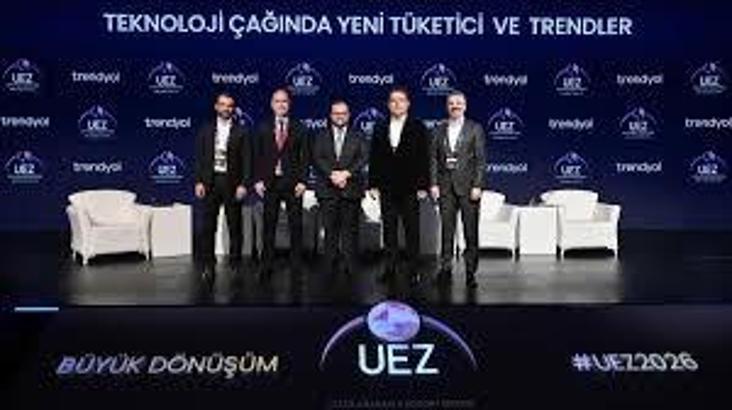
The second panel of the day, sponsored by Tera Finance Group, was titled ‘The New Consumer and Trends in the Age of Technology.’ The panel, sponsored by Trendyol, was moderated by Simon-Kucher Global Partner and Managing Partner of the Türkiye Office, Cem Balıkçıoğlu.
Trendyol Group CEO Erdem İnan stated in his speech that global operations are increasingly shaped by artificial intelligence and advanced data technologies. He noted that Trendyol currently ships more than 200,000 products daily to 35 countries, emphasizing that this scale is supported by a strong technological infrastructure.
İnan said, “Artificial intelligence is a critical lever that removes many barriers in e-commerce. The developed language models go beyond product translation. We have established a structure that can instantly respond to customer questions and generate content suitable for different geographies. We can re-edit videos and visuals according to different markets. This allows for mass-scale personalization. AI also plays a critical role in logistics. We deliver 40 million products to 35 countries via land, sea, and air using three different models. We can instantly optimize the most suitable logistics solution based on the customer’s time and price sensitivity.”
İnan also noted that the AI transformation initiated in internal processes has been extended to sellers. “We have developed AI-supported agent workflows to reduce the weekly operational workload of our sellers by 50–60 hours. Today, more than 20,000 sellers actively use this system. We observe that they achieve up to 35% time savings and are able to increase their sales,” he said.
‘WE ARE A MODERN, ORGANIZED AND DIGITAL GROCERY STORE’
Migros CEO Mustafa Murat Bartın emphasized the essence of retail and discussed the company’s transformation through data and technology. Stating that the core of retail has not changed, Bartın said, “We still sell cheese, tomatoes, bread, and detergent. In fact, we are a grocery store. But we are a modern, organized, and digital grocery store. Migros’s digitalization journey started early. In 1997, we launched Migros Virtual Market. This was one of the first digital grocery applications initiated by a physical retailer in the world. Migros is also the first physical retailer to obtain a service banking license. We will soon launch our applications in this area.”
Bartın added that data lies at the core of this transformation; “If we had not established a loyalty program in 1997 and processed that data correctly, reaching today’s level would not have been possible.”
‘CONSUMERS ARE NOT GIVING UP ON PROMOTIONS’
Unilever Türkiye Country President Ali Fuat Orhanoğlu said, “Artificial intelligence is one of the most frequently used concepts. The second important concept is resilience. It is almost embedded in us. Turkish consumers shape their shopping behavior with resilience and adaptability. They generally make the most rational and correct decisions. Currently, due to relatively high interest rates and a downward trend in inflation, shopping frequency has increased while basket size has slightly decreased. Consumers are reducing stockpiling. At the same time, sensitivity to promotions has significantly increased. Previously, the rate of consumers who switched stores to find promotions was 21%, now it has risen to 42%. This behavior will continue among Turkish consumers. We are also adapting ourselves accordingly. We focus on how to create demand and stay relevant in the digital environment. Companies that succeed in this will win.”
‘DEMOGRAPHIC STRUCTURE IS CHANGING THE CONSUMER PROFILE’
Ipsos Türkiye CEO Sidar Gedik stated that a demographic transformation is taking place globally. He emphasized that this is a critical issue affecting the rules of the game; “The most important factor behind this is the rapid aging of the global population. According to UN projections for 2030, one in every six people worldwide will be over the age of 60. In Türkiye, the proportion of people aged 65 and over has already exceeded 15%, above the WHO threshold of 10%. This aging trend also brings changes in household structures. Currently, 5,5 million people in Türkiye live alone. All these factors show how consumers are evolving. Demographics are not only about age; migration also plays a role. Around 300 million people worldwide are migrants. Wars are a factor, but the main driver of migration is economic. Migration will become increasingly necessary in the future. Europe faces a risk in terms of financial sustainability. They will either extend the working age further, encourage higher birth rates, or accept more migrants. In the coming decades, we will see migration from the southern hemisphere to the north. We need to consider that consumer profiles will increasingly consist of older, more isolated individuals who were not born in the country they live in.”